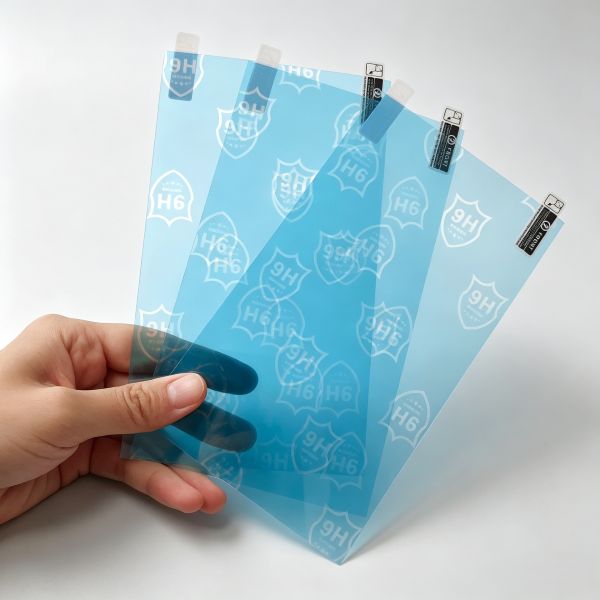
PET Protective Film
Polyester (PET) protective film — high transparency, high cleanliness, flat without warping. Good temperature resistance, low residue. Suited for screen, panel and glass surface protection during transport and processing.
Key Features
- High transparency & cleanliness, no appearance impact
- Flat without warping, tight fit
- 120°C rated for processing environment
- Low residue, clean removal
Applications
Screen surface protection · Panel protection · Glass surface protection · High-gloss panel protection
Material Tags
Technical Parameters
| Substrate | PET (polyester film) |
|---|---|
| Thickness | 0.03–0.10 mm |
| Adhesion | 5–500 g/25mm |
| Temperature | −20 ~ 80 °C |
| Residue | Low / None |
| Feature | High transparency & cleanliness |
| Processing | Die-cut / Class 1000 cleanroom |
Frequently Asked Questions about PET Protective Film
Common questions about die-cutting and material selection for this product
How to Choose Protective Film Adhesion?
Choose adhesion by application: low tack (3-50g/25mm) for polished surfaces and optical lenses; medium tack (50-150g/25mm) for general metal and plastic surfaces; high tack (150-500g/25mm) for rough surfaces or long-term protection. Wrong adhesion causes residue (too high) or peeling (too low). We recommend prototype testing first.
What's the difference between silicone and acrylic protective film?
Silicone protective film withstands high temperature (up to 250°C), leaves no residue, and ages well — suited for high-temp processes and optical-grade surfaces. Acrylic film has more stable adhesion and lower cost, suited for room-temperature protection. Silicone film for high-end (screens, optics); acrylic for general industrial protection.
What scenarios suit PU self-healing protective film?
PU (polyurethane) self-healing film auto-repairs minor scratches, suited for automotive paint protection (PPF), premium surfaces (brushed metal, high-gloss panels), and electronics housings. Thickness 0.05-0.15 mm, high transparency, no impact on appearance. Note: PU film is soft — use low-tension feeding and sharp dies when die-cutting.
Have more questions? Our technical team is ready to provide one-on-one consultation
Contact Us