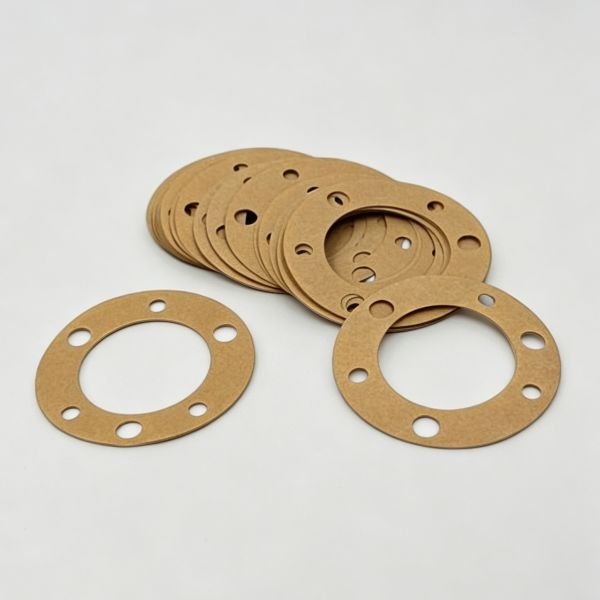
DMD Insulation Paper
Polyester film and polyester fiber three-layer composite insulation paper (DMD), designed for motor/transformer slot insulation. Thermal Class F (155°C), with high dielectric strength, excellent mechanical strength and dimensional stability. The standard choice for motor slot and transformer interlayer insulation.
Key Features
- Thermal Class F (155°C) for high-temperature use
- Good mechanical strength, tensile & tear resistant
- Dielectric strength ≥2 kV
- Dimensionally stable, high processing precision
Applications
Motor slot insulation · Transformer interlayer insulation · Electrical winding insulation · Generator insulation
Material Tags
Technical Parameters
| Material | Polyester film + polyester fiber (3-layer) |
|---|---|
| Thickness | 0.15–0.50 mm |
| Dielectric Strength | ≥ 2 kV |
| Thermal Class | Class F |
| Temperature | −40 ~ 155 °C |
| Processing | Die-cut |
| Die-Cutting Tolerance | ±0.10 mm |
Frequently Asked Questions about DMD Insulation Paper
Common questions about die-cutting and material selection for this product
PET vs PC Insulation Sheet — Which is Better for Die-Cutting?
PET film offers good rigidity and moderate temperature resistance (-60 to 150°C), suitable for thin insulation (0.025-0.25mm). PC provides better impact resistance and higher temperature tolerance (-100 to 130°C), ideal for thicker insulation parts (0.25-1.0mm). Battery insulation typically uses thin PET; structural insulation uses thick PC.
What are the special requirements for battery insulation sheet die-cutting?
Lithium battery insulation sheets must meet flame-retardant standards (UL94 V-0), have burr-free edges (to avoid puncturing the separator), and tight thickness tolerance (±0.02 mm). Die-cutting should be done in a cleanroom to prevent metal particle contamination. Common materials: PET film, flame-retardant PP, and DMD composite insulation paper.
How to prevent DMD composite insulation paper from delaminating after die-cutting?
DMD is a three-layer structure (PET film bonded to polyester fiber paper on both sides) that delaminates easily if mishandled. Solutions: use sharp dies (etching dies outperform laser), control pressure to cut through in one pass without burrs, and use flat-bed dies rather than rotary for thick DMD (>0.25 mm).
Have more questions? Our technical team is ready to provide one-on-one consultation
Contact Us